Aug 5, 2010 | Hiroshima in the Morning, Our Nuclear Age
On the 65th anniversary of the bombings of Hiroshima and Nagasaki, we risk losing the memories of the survivors.
I went to Hiroshima in 2001 to interview the hibakusha — literally, the “bomb-affected people.” I made this journey as a Japanese-American woman who had no knowledge of the atomic bombings — no experience of war at all.
When I got to Hiroshima in June 2001 and began my interviews, good-hearted people shared their testimonies with me, all beginning with where they were the moment they saw the plane, where they fled to, and who among their family and friends survived. Even those stories with some gore in them — descriptions of how the six rivers of the Hiroshima delta were so swollen with bodies that you couldn’t see the water — were curiously detached. It was not that they were afraid to offend the American interviewer. It was that they had forgotten precisely what it felt like.
The survivors recited the facts I had found in books: 100,000 dead within days, 100,000 more dying; everything within two kilometers irradiated; thirteen square kilometers burned to the ground. Drinking the water was deadly. Small fleshy body parts, like ears and noses, melted long before the people themselves died.
Often, the hibakusha ended our conversations with a speech about the need for peace and nuclear disarmament. There were even people who expressed their belief that the world was already at peace, and that, by dying spectacularly, the victims of Hiroshima had made it impossible for any sane leader to use nuclear weapons again.
I couldn’t bring myself to tell them that their sacrifice was almost invisible where I came from. Photos, film, documentation of the city had been confiscated and censored almost immediately after Japan surrendered, and the only indelible image of the bombing was the power of the bomb itself: the “shock and awe” version of the mushroom cloud. John Hersey’s Hiroshima, first published in 1946, remained the only “oral history” account released by a major, commercial American press. As a result, most Americans know almost nothing about nuclear fallout beyond the 1950’s advice to stock your bomb shelter with canned food.
But after September 11, 2001, when terrorism exploded on television, the interviews began to change.
Witnesses recalled being trapped under beams, screaming to be saved from the tornadoes of fire that were whipped up as the shock wave advanced. One woman I spoke with, who was about eight at the time, told me about trying to fit her mother’s eye back into its socket. Another remembered giving her child water and watching his lips attach and pull off onto the spout of the kettle. One man said:
They brought my sister home, lying on a door. She died the next night, calling, ‘Mother, help me, please.’ My sister’s agony, her terrible burns, her skin slithering off… it was common at the time.
The global instability — the terrorist attacks, the anthrax, the war in Afghanistan — had seeped into the past and made the kind of unconscious link between inhumanities that only trauma can. The hibakusha had been stripped of their trust in the future, and they passed that insecurity to me.
In 2001, living at the world’s first “ground zero” and watching on TV as my New York City home adopted that label, war seemed to be an act that could only be possible if we could fool ourselves into believing that other people’s children were not as precious, or human, as our own.
Hiroshima should have taught us not to be such fools.
This article was first published by the Progressive Media Project. When I sat down to write something for this anniversary, I realized that nothing has changed, except the date. So I changed the date. It is now also available on The Huffington Post and Discover Nikkei.
Jun 12, 2010 | Random Thoughts
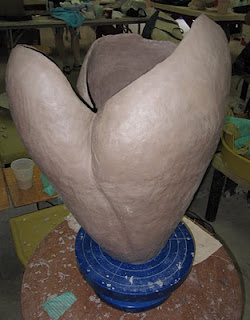
Ming just returned from a five-day ceramics workshop. He was learning about wedged coil building, which is something he has never done. He loves the wheel, and he is used to making four pieces in an afternoon; but last weekend, it took him four days to finish a single piece.
Every night when I talked to him, he said, I don’t know what I’m doing, I can’t get this done, the clay is too wet, the clay is too dry… He was beginning to face the fact that he might not have a single piece from the entire workshop. It was a new experience for him not to know where he was going, not to be comfortable as he was creating. And every day, the piece changed. Other potters would say, That looks good. Why don’t you stop? Isn’t it done? But it wasn’t.
It was a lesson about time. About how time is an ingredient too. I thought of my own memoir, coming out nine years after I lived it. After two years, the draft I had was too full of me and had to be slashed in half. After four years, the draft became a hybrid novel/memoir; after six years, a meditation on narrative that manipulated form so the memoir moved from third person into first as personal awareness was earned. Now, all of that artifice has fallen away – a gift of time – and the final book is tightly woven and startling to me: this week I read the page proofs, looking for typos and for sections that I will read in public, and I found myself, at times, in tears.
It was the gift of time that I found the courage, in now-forgotten moments over these last nine years, to write this way. It was the gift of time that I could see a bigger picture, a different angle, a universal experience in these little things that happened to me. Each morning, the artist wakes up and looks at the world from a new place. And finally finds himself in the right frame of reference to finish the biggest, most organic piece of work he has ever produced on the very last day of the ceramics workshop.

Feb 20, 2010 | Random Thoughts
To mark today – which is the Day of Remembrance for the Japanese-Americans, the 68th anniversary of the Executive Order that would put 120,000 people of Japanese ancestry into American internment camps – a small excerpt from the manuscript of my new memoir, Hiroshima in the Morning:
“There’s a little girl in my head with Shirley Temple curls and freckles playing in a dustswept road. She is the enemy. She looks about six, even though she shouldn’t be: my mother was not five when she was released from the internment camp, but no pictures survive from that time so age six is the youngest image I have of my mother, the only image I have from ‘war time’ was taken after the end of the war. Of course, this little girl – skirt flying, dancing with tumble weeds – is not my mother, not exactly. She is my first character from my first book.
My mother could not remember the camps, so I invented them for her. That’s how my first novel began. I made them up, pulling from a mixed bag of the photographs that could be taken, from the questions that the man with the year book at the internment camp “reunion” had asked, the man who wandered through the community center full of former internees eating home lunches of sushi rice and teriyaki, searching for anyone in the room who was three when he was three in camp, who might have been in a nearby block, who might have been his friend.
I pulled from dreams.
I created the children first – this little boy, the little girl who was his friend – and even while I was doing interviews, gathering the details of how the brick floors in the barracks had to be shellacked to keep the dirt from rising, I must have known I wasn’t dreaming up a “book about the internment.” Write a potboiler, a kindly, grandfatherly man had told me in passing, in the halls of one of the elder homes I visited to do my interviews. That’s what people want to read. The facts are boring. His advice stuck, though I was never aware of following it. I began to fictionalize, to trace family ties that could never have existed but could still be realized and, more than that, could be made so persuasive that my mother could fill in her past with them, tucking her adopted life into bed each night without acknowledging its true parentage until it was hers by nurture. I recreated my mother’s memories before she began to lose her own, and now she too cannot remember what is real. I have been left with fragments of my own creation, with fictions, and now that I am in Japan, I’m discovering new creations and new memories of my mother – older, different – of times with her that I never experienced.”